


White Rhinoceros Ceratotherium simum
Despite the name, none of the rhinoceros species still living in the world today is actually white.
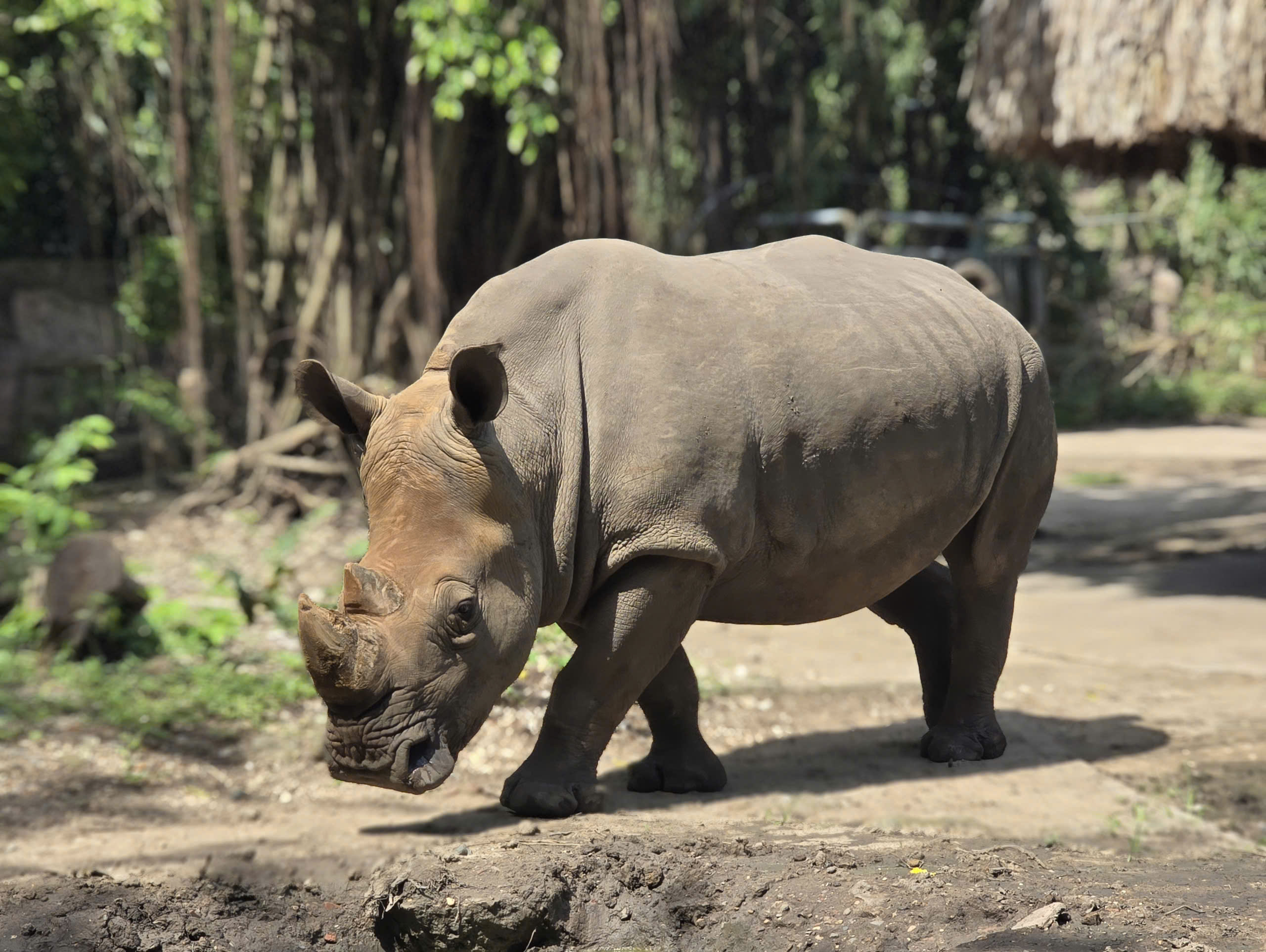
In the 17th and 18th centuries, Dutch settlers in Africa encountered a huge animal with a broad, flat, square-shaped upper lip, perfectly adapted for grazing close to the ground. In Dutch, this feature was described as “wijd,” meaning “wide” or “broad.” When the British later arrived, they mistakenly understood “wijd” as “white”, as the two words sounded quite similar. And so, the name “white rhino” was born.
As a way of dealing with the confusion, they then gave the name “black rhino” to another African rhinoceros species that they had discovered earlier. This species has a pointed upper lip adapted for feeding on branches and leaves, hence the name “black rhino.”
Perhaps that is why children, those inexperienced little humans, can sometimes be seen sulking and complaining to their parents or grandparents in this area. They refuse to move on to another part of the zoo:
“I want to see the white rhino!”
After spending all that time sounding out the animal's name, they still cannot seem to find a white-colored animal anywhere.
Fortunately, the area around the white rhino enclosure also features several other African species, including giraffes, scimitar-horned oryx, and zebras, along with a sandy playground filled with children's activities. This gives parents plenty of ways to persuade their little ones to move on. Otherwise, the consequences could be rather unpredictable.
The two white rhinoceroses living here are similar in size, but quite different in age. Van Bi is more than a decade older than Thi Bo. Perhaps that is why the two did not get along from the very beginning.
At first, keepers even installed an electric fence to separate the pair, but it did not work because a rhino's horn, which is made of tightly woven keratin fibers, does not conduct electricity.
Their conflicts continued again and again.
Later, the pair were given a much larger and more comfortable home, but neither of them was willing to give in to the other.
For all their enthusiastic fighting, however, both Van Bi and Thi Bo are very fond of visitors, especially children. On weekend afternoons, they often spend a considerable amount of time standing around while children watch them, gently touch them, feed them, and take photos.
No one has ever seen either rhino become annoyed when children stroke their cheeks or gently touch their horns.
Thi Bo especially likes to stand still with her head resting against her familiar railing, enjoying the affection coming from those tiny, soft hands. She seems to enjoy being pampered, a feeling that Van Bi has never shown much interest in expressing over the years.
Whenever the children offer her a piece of corn or a carrot, she happily takes it and eats every bit, as if to say:
“I would never turn down the kindness you show me.”
Van Bi and Thi Bo also have one rather naughty habit: they love mud baths.
Rolling around in muddy pools does not make their skin any lighter. Quite the opposite, it leaves them looking even darker.
In the wild, covering themselves in mud is much like putting on a suit of armor. The layer of mud helps protect them from the discomfort of the scorching sun and shields them from biting and stinging insects.