


Crocodiles are ancient giant reptiles that have survived for more than 200 million years to the present day. Their bodies are highly adapted to life both on land and in water. Their thick armored skin protects them from predators and helps them withstand harsh weather conditions, while their highly effective hunting abilities ensure a reliable food supply for survival.
Crocodiles have one of the strongest bite forces among land-dwelling animals, even stronger than that of hippos. By combining an extremely powerful bite of around 3,700 psi with violent twisting and thrashing movements, they can make it nearly impossible for prey to escape their deadly jaws.
The eyes, nostrils, and ears of a crocodile are positioned along the top of its head, allowing it to remain mostly submerged while still easily observing and sensing what is happening above the water. In water, crocodiles can see their prey thanks to a special membrane known as the third eyelid. This membrane acts much like swimming goggles: it closes underwater to protect the eyes while still allowing the crocodile to see.
In addition, crocodiles in the family Crocodylidae have highly sensitive sensory organs distributed across their bodies, allowing them to detect even the slightest vibrations in the water from considerable distances.
Unlike many other reptiles, crocodiles have a fully developed four-chambered heart, similar to birds and mammals. They also possess the foramen of Panizza, an opening connecting the two aortic arches that allows blood flow to be redirected when the animal dives deeply or needs to increase stomach acidity to digest bones.
This is one of the key adaptations that allows crocodiles to digest large quantities of animal bones without having to chew or crush them extensively. Crocodiles also swallow stones and gravel, which remain in their stomachs and help with digestion as well as with maintaining their body weight while diving.
Caring for such a dangerous reptile requires keepers to be physically fit, quick, cautious, and meticulous. The dozens of crocodiles scattered among the vegetation, rocky areas, and pools throughout the Crocodile Garden are all cold-blooded predators.
Crocodiles rarely distinguish between familiar and unfamiliar people. To them, anyone who accidentally comes within striking range may be considered potential prey. The same is true at Saigon Zoo and Botanical Gardens. Knowing a few of their names does not mean you can simply walk into their enclosure when you call them.
Unlike the gentle-sounding names such as Mỹ Mỹ, Mỡ Mỡ, Đình Đình, Tuyết Tuyết, and Hoàn Hoàn, the crocodiles here are long-lived and large-bodied. They are more than capable of outsmarting you and overpowering you with a single bite.
The care routine for these cold-blooded residents always requires two keepers to observe and support each other. Before entering the enclosure, they must first locate every crocodile inside. The basic rule is to never allow a crocodile to remain behind them. The crocodiles are guided toward one side of the enclosure, keeping them in front of the keepers where they can be observed more easily.
Before entering the enclosure, the crocodiles are fed until they are full, helping to reduce their aggressiveness. Because crocodiles have different biological habits from many other animals, keepers only need to enter the enclosure twice a week to clean the area and change the water in the pool. This also helps reduce the risks involved.
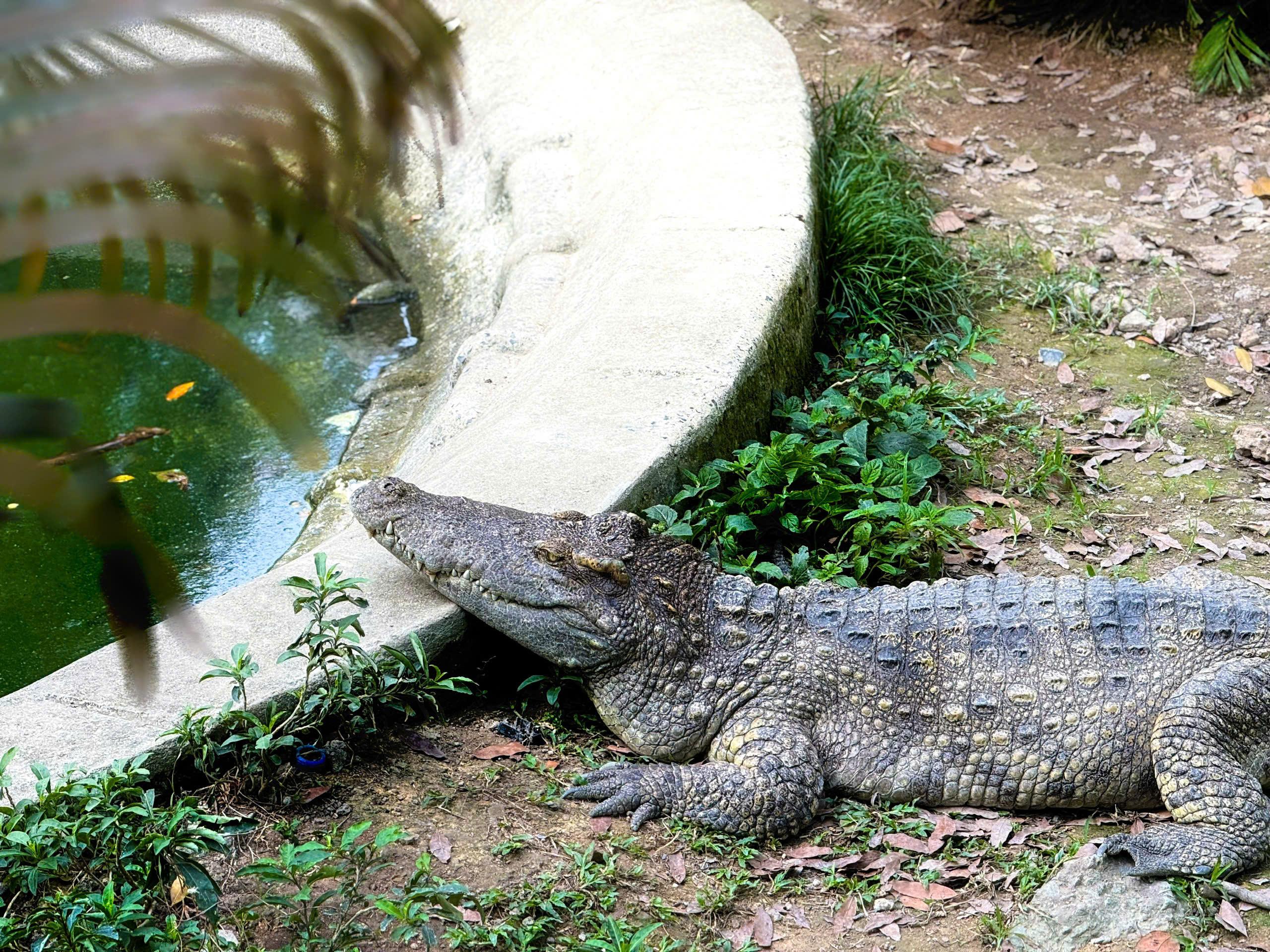
After a full meal, crocodiles usually look for a dry, sunny spot where they can bask, absorb heat, and digest their food. At such times, they can look remarkably like statues.
For a while, rumors even circulated that Saigon Zoo and Botanical Gardens displayed fake crocodiles. Some skeptical visitors would throw objects at them just to see whether they moved.
Thanks to ongoing public education and clear informational signs, visitors throwing bricks, stones, bottles, or cups at the crocodiles, or throwing rubbish into their enclosure, has now become very rare. As a result, the crocodiles can peacefully bask in the sun, while the keepers can carry out their work more safely and with less difficulty.
The Crocodile Garden at Saigon Zoo and Botanical Gardens is home to two crocodile species: the Saltwater Crocodile, also known as the Estuarine Crocodile (Crocodylus porosus), and the Siamese Crocodile, also known as the Freshwater Crocodile (Crocodylus siamensis).
Among them, the Saltwater Crocodile is the largest crocodile species in the world. It can thrive in a wide range of aquatic environments, from freshwater rivers and lakes to brackish and saltwater habitats around river mouths and coastal areas.
Although crocodiles are widely kept on farms and in zoos, they have almost disappeared from the wild in Vietnam.
In 1996, Saigon Zoo and Botanical Gardens worked with international organizations and Cat Tien National Park to return a group of captive-bred crocodiles to the wild at Bau Sau. Today, Bau Sau has become a familiar destination for visitors who love nature and wildlife.