


Tetrameles
Scientific name: Tetrameles nudiflora R. Br.
English name: Tetrameles
Family: Tetramelaceae
Local names: Tung
Characteristics
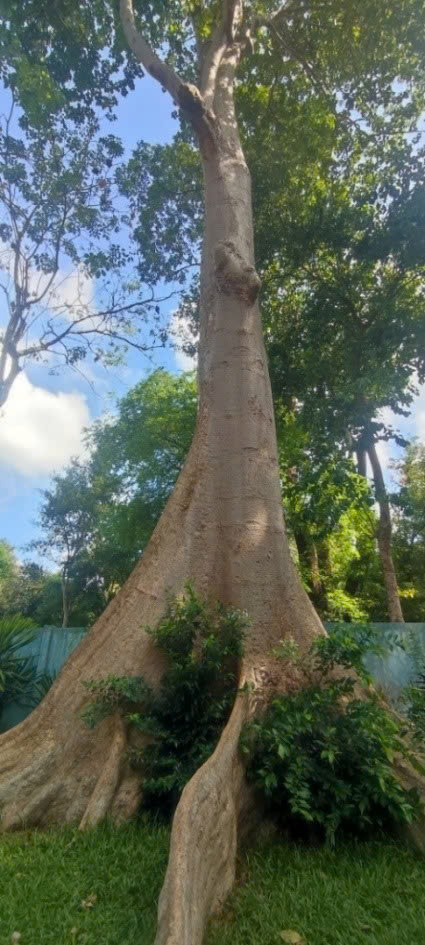
Tetrameles is a large deciduous tree that can grow to over 40 meters in height, with a trunk diameter of 1 meter or more. The trunk is straight, and the base develops prominent buttress roots. The bark is pale grey to whitish.
The leaves are simple, egg-shaped to nearly round, about 12 to 15 cm long and 10 to 13 cm wide. They have a heart-shaped base and a short pointed tip. Young leaves are hairy on both surfaces, while mature leaves become almost smooth. Each leaf has 4 to 6 main veins arising from the base, and the leaf stalk is 5 to 12 cm long.
The flowers are unisexual, with male and female flowers borne on separate trees, and they appear before the new leaves emerge. The flower clusters are hairy:
- Male flowers grow in clusters, with 4 sepals, no petals, and 4 stamens
- Female flowers grow in long panicles, with an ovary topped by 4 short styles
The fruit is dry and egg-shaped, splitting open at the tip when mature. It contains many small, flat seeds.
Ecology
This is a light-loving, fast-growing species, commonly found in humid tropical forests, especially on red basalt soils.
It sheds its leaves seasonally and flowers before producing new foliage, a distinctive ecological feature that makes it easier to recognize in the wild.
Natural Distribution
In Vietnam: Found in places such as Cúc Phương National Park, Cát Tiên, Bù Gia Mập, and Côn Đảo.
Worldwide: Widely distributed across South and Southeast Asia, including India, Nepal, Myanmar, Thailand, Laos, Cambodia, China, Indonesia, Malaysia, and New Guinea.
Value
Genetic value: Tetrameles is the only species in the genus Tetrameles, giving it significant scientific value.
Timber: The wood is light and soft, and is used in construction and for household items.
Traditional uses: The bark can be used as a laxative in traditional medicine.
Although it was once fairly common, the number of individual trees has declined rapidly due to logging and habitat loss, especially as red basalt forest areas have been converted to industrial crop plantations.
Location
Near the large bird enclosure, Saigon Zoo & Botanical Gardens.